
Level:
Beginner
Duration:
10 weeks or more (split between courses)
Application Announcement
The registration will open soon!
Eligible candidates will be invited to the placement test.
To be eligible for the placement test, the candidate must be enrolled in the KAUST Academy/Coursera program within 3 days of receiving Coursera invitation and then complete the required pre-requisite courses within the recommended period, otherwise the Coursera subscription will be revoked and passed on to other applicants on the waiting list.
Requirements
1- You must be a university student currently enrolled in a university, or recently graduated within two years.
2- The accepted applicants’ age range is between 18 and 30, inclusive.
3- You must complete the prerequisite courses on Coursera.
4- Passing the assessments at each stage. Top qualified students will be invited to the next stage.
*Compulsory Step
Prerequisite Core Courses
To qualify for the Artificial Intelligence Specialization Program, you’ll need to sign up for Coursera within 5 days of receiving the invitation link at your registered email address, and then successfully complete one of two tracks to be eligible to take part in the placement test:
Prerequisite Courses of Artificial Intelligence – Python Basics
Prerequisite Courses of Artificial Intelligence – Mathematics
Students with top scores in the placement test will receive invitation for (Introduction to AI) to join a one week in person training during university breaks. At the end of the course, students with top performance will be invited to another one week in person training (Advanced AI) and take an exam at the end of the course as well.
The top qualified students will receive invitation to participate in a variety of KAUST Academy Summer Programs at elite partners institutions in KSA and/or abroad including Summer School, Internships, and Research Programs.
Students who will not be selected after passing the placement test in December, will still have access to over 200 courses, specializations, guided projects and more on Coursera until August 2026. They will be eligible to receive a free certificate for each achievement on Coursera during that period.
Covered topics in this course

- Basics of R
- How to analyze bulk RNAseq Count Data
- Basics of Python
- How to analyze single cell RNAseq count data
Skills you’ll gain
R Basics
Bulk RNAseq Analysis
Linear Algebra
Python Fundamentals
Data Visualization
Statistical Analysis
RNAseq Techniques
Python Coding
Student Journey
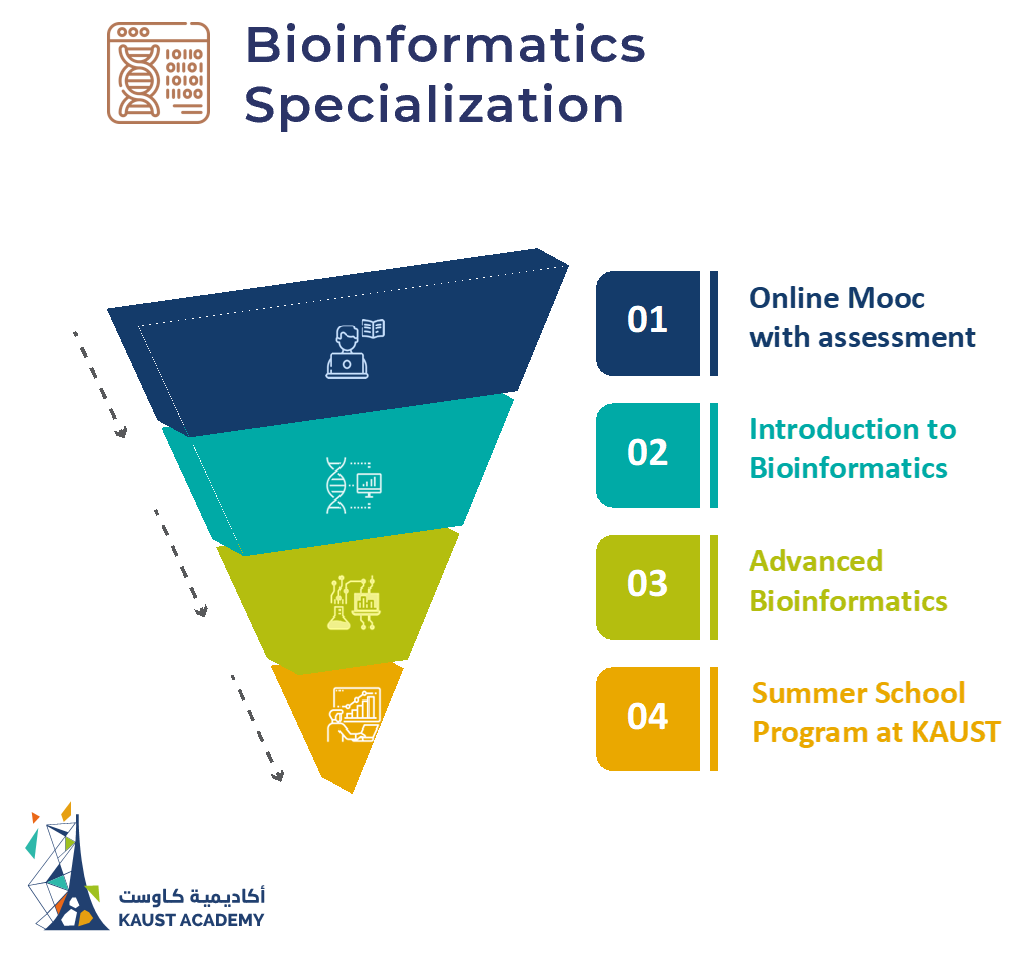
Stage 1: Prerequisite Course
Method:
Self-Paced, Online Courses
Duration:
2 to 4 Weeks
Completion Date:
Early November
Important Note: Signing up for the prerequisite courses on Coursera (Stage 1) does not guarantee participation in subsequent stages. Students must demonstrate their knowledge and skills by excelling in the assessments to progress through the program. Certificates of Completion will be awarded at each stage to acknowledge participants’ achievements. Qualified students will be invited to the next stage.
Description: The students are required to complete 2 auto-enrolled course on Coursera, supplying them with the knowledge for Bioinformatics essentials and building blocks.
Stage 2: Introduction to Bioinformatics
Method:
Instructor-Paced, In-Person Lectures
Duration:
5 days
Start Date:
During university breaks 2025/2026
Description: Top qualified students will delve deeper into the world of Bioinformatics, learning the skills and tools to apply this newfound knowledge in their fields. The program will cover a wide range of topics, including Introduction to Bioinformatics and Biological Resources, Sequence Alignment and Phylogenetics, Genomics, Metagenomics, and Transcriptomics, and Proteomics and Structural Bioinformatics, equipping students with the expertise needed to address complex biological challenges.
Stage 3: Advanced Bioinformatics Course
Method:
Instructor-Paced, In-Person Lectures
Start Date:
During university breaks 2026
Duration:
4 Days
Description: The qualified students will delve even deeper into the world of Bioinformatics, learning about advanced theories and applications of bioinformatics technologies. The program will cover specialized topics such as Advanced Genomics, Advanced Transcriptomics and Epigenomics, Systems Biology and Network Analysis, and Machine Learning in Bioinformatics, providing students with the tools and knowledge to work on cutting-edge research and solve complex biological problems.
Stage 4: Bioinformatics Summer Program
Method:
Instructor-Paced, In-Person Lectures
Start Date:
June, 2026
Duration:
8 weeks
Description: Qualified students will be invited to the prestigious KAUST Academy Summer Program in one of KAUST Academy top partner institutions in KSA or abroad. Students will be provided with on-campus accommodation and privileges.
Prerequisite course agenda
This section provides a detailed agenda, outlining the specific segments of the Coursera specializations to complete and their recommended timelines. The aim is to ensure participants finish these courses in time for the qualification exams. For the first cohort, the target completion date is before November 1, 2024. For the second cohort, the target completion date is before December 12, 2024.
Module 1 : Introduction to Programming (using R)
Module 2 : Introduction to Programming II (using R)
Module 1 : Programming Python
Module 2 : Bioinformatics case study - RNA-seq bulk and single-cell data analysis
Module 1 : Hands-on Introduction to Linux Commands and Shell Scripting
Module 2 : Hands-on Introduction to Linux Commands and Shell Scripting

Professor’s Take on the Course
“Bioinformatics brings together ideas from biology, mathematics, engineering and computer science to answer questions about complex biological systems. Using advanced ideas from statistics and machine learning to deal with huge data sets, these ideas are fundamental to the future of personalised medicine.
.” – Professor Paul Fannon, Assistant Professor in Mathematical and Computational Biology, University of Cambridge
Thousands of happy learners

Personally, I was having a hard time choosing a path for my career, but learning about all the different topics that emerged from AI was an eye-opening experience that made me realize the relevance of AI to the development of our beloved country. Now, I’m more confident than ever about what I want to do.
Faisal Alharthi
Personally, I was having a hard time choosing a path for my career, but learning about all the different topics that emerged from AI was an eye-opening experience that made me realize the relevance of AI to the development of our beloved country. Now, I’m more confident than ever about what I want to do.
Faisal Alharthi
Personally, I was having a hard time choosing a path for my career, but learning about all the different topics that emerged from AI was an eye-opening experience that made me realize the relevance of AI to the development of our beloved country. Now, I’m more confident than ever about what I want to do.
Faisal Alharthi
Personally, I was having a hard time choosing a path for my career, but learning about all the different topics that emerged from AI was an eye-opening experience that made me realize the relevance of AI to the development of our beloved country. Now, I’m more confident than ever about what I want to do.
Faisal Alharthi
Personally, I was having a hard time choosing a path for my career, but learning about all the different topics that emerged from AI was an eye-opening experience that made me realize the relevance of AI to the development of our beloved country. Now, I’m more confident than ever about what I want to do.
Faisal Alharthi
Personally, I was having a hard time choosing a path for my career, but learning about all the different topics that emerged from AI was an eye-opening experience that made me realize the relevance of AI to the development of our beloved country. Now, I’m more confident than ever about what I want to do.
Faisal Alharthi
Frequently Asked Questions (FAQ)
Who can apply for this program?
Saudi students and recent graduates in Saudi universities majoring in science and/or technology relevant fields.
How do I start this program?
By signing up and completing the prerequisite (online) courses via Coursera.
Is there a tuition fee for the KAUST Academy Specializations Program?
The program is currently offered with a full scholarship for talented students at all Saudi universities.
Is this training program for technical professionals?
No, this training program is catered to Saudi students and recent graduates in Saudi universities to well prepare them for the ideal career opportunities in the Kingdom and/or abroad.
Will I be able to apply AI concepts in real-world scenarios after this course?
Absolutely. The course emphasizes practical programming and covers foundational concepts that are applicable to real-world AI solutions.
How much time should I dedicate to the course each day?
(Stage one) Prerequisite online course is self-paced, suggested completion time is 3 to 5 weeks.
(Stages 2, 3, and 4) Introduction, Advanced, and Summer Program) are full day in-person training and instructor-paced. They will will take place during university breaks.
How do I get invited to the placement test in stage one?
To qualify for the placement test, you are required to successfully complete only the pre-requisite course(s) which are auto-enrolled to your access upon joining Coursera.
Will I receive a certificate upon completion?
Yes, participants who successfully complete the online course(s) and/or the in-person courses will receive a certificate of completion to showcase their newfound knowledge and skills at each stage.
How do I qualify for the in-person training and reach the fourth stage (summer program)?
The program consists of four stages with assessment after each stage to get qualified to the following one. Top performing students will be selected to advance further until they successfully reach the summer program.
How could I benefit from this training program if I could not get selected to the in-person course?
Students who successfully complete the pre-requisite courses on Coursera will be already benefited from this program even if they do not get selected to the second stage.
Do not forget that you have free access to over 200 courses, specialization, guided projects, and more through the KAUST Academy/Coursera license.
We strongly recommend that you enroll, complete and earn free certificates for as many courses as you like, during the entire period of the program.
What will the placement exam look like ?
- Question: In Python, if you create a new list b as a clone of list a using slicing (b = a[:]), which of the following statements is true?
- a and b are the same list, and any modification to a will also reflect in b.
- a and b are different lists, but they share the same memory address.
- a and b are different lists, and modifications to b do not affect a.
- a and b are different lists, but modifications to a will still affect b.
Answer: C
- Question: The Hessian matrix of a function f(x, y) is a matrix of:
- First partial derivatives of f with respect to x and y
- Second partial derivatives of f with respect to x and y
- Mixed partial derivatives of f with respect to x and y only
- Derivatives of f with respect to time
Answer: B
- Question: Which line correctly writes a list athlete = [“John”, 28, “Basketball”] as a CSV row?
- write(“,”.join(athlete) + “\n”)
- write(“,”.join([str(item) for item in athlete]) + “\n”)
- write(“Name, Age, Sport\n” + athlete + “\n”)
- writelines(“,”.join(athlete))
Answer: B
- Question: If class Dog inherits from class Animal, which of the following statements is true?
- Dog can access all methods and attributes of Animal.
- Animal can access all methods and attributes of Dog.
- Instances of Animal can call methods defined only in Dog.
- Dog and Animal have no relationship unless explicitly specified in each method.
Answer: A
- Question: If the correlation coefficient between two variables X and Y is -0.85, which of the following is true?
- X and Y have a strong positive relationship.
- X and Y have a weak negative relationship.
- X and Y have a strong negative relationship.
- There is no relationship between X and Y.
Answer: C
- Question: Given two lists, names = [“Alice”, “Bob”, “Charlie”] and ages = [25, 30], what will list(zip(names, ages)) return?
- [(“Alice”, 25), (“Bob”, 30), (“Charlie”, None)]
- [(“Alice”, 25), (“Bob”, 30), (“Charlie”, 0)]
- [(“Alice”, 25), (“Bob”, 30)]
- [(“Alice”, 25), (“Bob”, 30), (“Charlie”, “Unknown”)]
Answer: C, Explanation: zip stops at the shortest list, so “Charlie” is ignored.
- Question: Which feature scaling method is equivalent to calculating the z-score (standardizing to have mean 0 and standard deviation 1)?
- Min-max scaling
- Robust scaling
- Standard scaling
- None of the above
Answer: C
- Question: Why is the characteristic equation of a matrix important in linear algebra?
- It determines if a matrix is invertible.
- It is used to calculate the eigenvalues of the matrix.
- It finds the trace of the matrix.
- It checks if the matrix is symmetric.
Answer: B
- Question: You have a DataFrame df with columns [‘Category’, ‘Sales’]. Which command will give the average Sales for each unique Category?
- groupby(‘Category’).mean()
- groupby(‘Category’)[‘Sales’].mean()
- groupby(‘Category’)[‘Sales’].average()
- groupby(‘Category’).count()
Answer: B